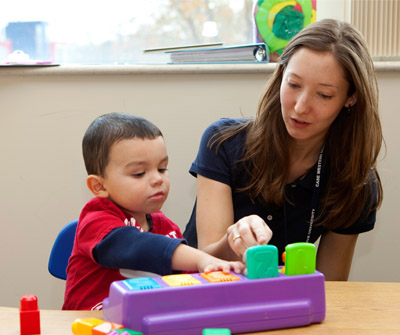
Playing with your child is a essential way to improve his/her speech, language, and social skills! Below are five different toys and ways to play with your child to encourage language growth and development:
Mr./Mrs. Potato Head:
- Following Directions: Ask your child to give you various parts. If this is too simple, ask him/her in a more complex way. For example, instead of asking for Mr./Mrs. Potato Head's shoes, say "the ones you put on your feet.” Sometimes this works best after the child has built Mr./Mrs. Potato Head and is asked to follow the directions of placing each part back into the box.
Read More
Tags:
Speech,
Language,
Communication,
Support,
Learning,
Voice,
toddler,
talking
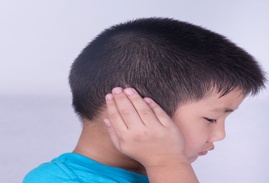
Summer is a time for kids and their families to enjoy a variety of water activities, which can increase the possibility of contracting Swimmer's ear.
Read More
Tags:
Hearing,
earplugs
Did you know…
- An estimated 40 million Americans experience speech, language, and/or hearing disorders.
- The second most common reason for special education services in public schools is speech/language impairment.
- 36 million American adults report so
Read More
Tags:
Speech,
Hearing Aid,
Audiology,
Language,
Hearing Aids,
Communication,
Hearing,
reading,
literacy,
Hearing Loss Prevention,
Teens,
Support,
Caregiving,
Hearing Loss,
Stuttering,
Learning,
Voice,
toddler,
talking,
Autism
Teaching your infant Baby Sign Language can help improve his or her communication skills. This is particularly appealing for new parents, given that there’s a gap between what babies and toddlers want to say and what they can verbally express.
Read More
Tags:
Speech,
Language,
Communication,
American Sign Language,
ASL,
Learning,
Voice,
toddler,
talking
Children who have been identified with speech-language impairments have likely established nonstandard patterns of speaking or have deficits that will require extra attention and training to improve. The speech-language pathologist (SLP) working with you and your child should serve as a "coach" to provide you with activities or homework to reinforce newly established skills and to strengthen emerging skills. One or two sessions a week is not enough, and your involvement in carryover activities is crucial to your child's communication development. Talk with your SLP about activities and games you can use at home to help.
Read More
Tags:
Speech,
reading,
literacy,
Teens,
Support,
Learning,
Voice,
toddler,
talking
Today, with the popularity of earbuds and other personal listening devices, it’s hard to know if your child or teenager is listening to music at a safe level. Back in the day, when stereo speakers were common, it was easier for parents to know how loud their children were playing music.
Read More
Tags:
Audiology,
Hearing,
Teens,
Support,
Hearing Loss,
"tinnitus"
The medical term for the perception of sound when no external sound is present is tinnitus. It is often referred to as “ringing in the ears,” although some people may hear a hissing, roaring, whistling, chirping, or clicking sound. Tinnitus may be constant or intermittent and may occur in both ears or just one.
Read More
Tags:
Hearing Aid,
Audiology,
Hearing Loss,
"tinnitus"
- “Huh? What Did You Say?”
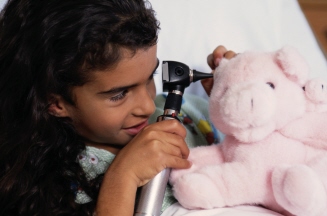
As parents, we all know that hearing and LISTENING are not the same. But, if it seems your child is experiencing hearing issues, even when it appears he/she is listening well, you should ask your child’s physician for an in-office hearing test or referral.
- Failed School Screening
School-aged children routinely have vision and hearing screenings conducted at school. Generally, parents are NOT notified unless there is a concern. If you receive a notice from your child’s school that he/she did not pass the hearing screening, please follow-up as the notice recommends.
- Teacher’s Report— Part I
Let’s face it, teachers spend A LOT of time with our children and are likely the first to notice if your child is experiencing hearing issues. Though, at times, it can be difficult to separate attention/focus from actual hearing ability, if your child’s teacher shares a concern, you should have it checked out.
- Teacher’s Report— Part II
Have you noticed a sudden drop in your child’s grades? Listening can be a tiring task when struggling with hearing. It can be easy for your child to “tune out” the teacher’s lessons, which can then impact his/her grades.
- “Why Is That Television So LOUD?”
Many kids like to raise the volume of the television. For some shows, like cartoons, it can make them seem more exciting and fun, but it could also be a sign that your child is experiencing hearing issues. If your child insists that he/she cannot hear the television at a level that you believe is typical, consider getting your child’s hearing tested.
- “Inside Voice, Please!”
Some hearing problems interfere with our ability to monitor the volume of our own voice. If your child seems to be talking either too loudly (or too softly), consider having his/her hearing checked.
- Recent Upper Respiratory Infection, Colds, Allergies, Flu
Anything that causes swelling in the back of the nose/throat area can cause secondary problems with middle ear health and hearing. Even if there is no fever or pain, your child could still have trouble hearing. If your child recently had a bad cold and, a couple of weeks later, seems to not be hearing well, have it checked.
- “I’m Hearing a Funny Sound!”
If a child reports any unusual noises in their head or ears (a ringing, rushing, roaring, beeping, hissing, etc.), particularly after being exposed to loud sound, have his/her hearing checked.
- Eagle Eyes
Children are marvelously adaptable to using what senses they can to figure out what’s going on and communicate! If you notice that your child seems unusually attentive to visual information and watching the faces of people speaking, have his/her hearing checked.
- “I Thought You Said…”
Does your child seem to mishear or misunderstand what was said? Some hearing problems are subtle and can interfere with hearing certain speech sounds. If this is happening, consider a hearing test.

Read More
Tags:
Communication,
Hearing,
Teens,
Hearing Loss
When traditional therapy doesn’t work: New treatment options for kids with persistent speech sound disorder.
Read More


%20(1).png?width=500&height=150&name=BWR2026_SaveTheDate_WebsiteBanner%20(1)%20(1).png)
_GreeceTripRaffle_DEV2026.png?width=500&height=150&name=Signature(Email)_GreeceTripRaffle_DEV2026.png)